
Band D in Hounslow is £2,185.56 for 2026/27, up £99.74. The full A to H table, the 2% social care precept, and the empty home premium that hits 400%.
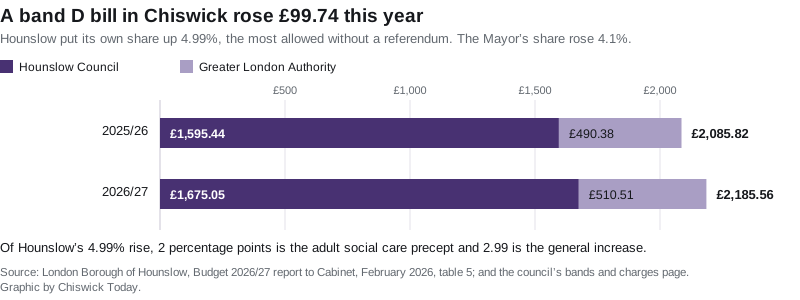
A band D home in Chiswick pays £2,185.56 in council tax in 2026/27. Hounslow Council takes £1,675.05 of that and the Greater London Authority takes £510.51.
The bill went up by £99.74, or 4.78%, on last year. Hounslow put its own share up by the maximum it can charge without holding a referendum, and the split matters: 2% of the 4.99% is the adult social care precept and 2.99% is the general increase.
Chiswick is in the London Borough of Hounslow, not Ealing and not Hammersmith and Fulham, even though the W4 postcode crosses into both. If your address is in Chiswick, Grove Park, Turnham Green or Strand on the Green, the table below is your bill.
The full band A to H table for 2026/27
| Band | Property value in 1991 | Hounslow Council | GLA precept | Total 2026/27 |
|---|---|---|---|---|
| A | Up to £40,000 | £1,116.70 | £340.34 | £1,457.04 |
| B | £40,001 to £52,000 | £1,302.82 | £397.06 | £1,699.88 |
| C | £52,001 to £68,000 | £1,488.93 | £453.79 | £1,942.72 |
| D | £68,001 to £88,000 | £1,675.05 | £510.51 | £2,185.56 |
| E | £88,001 to £120,000 | £2,047.28 | £623.96 | £2,671.24 |
| F | £120,001 to £160,000 | £2,419.52 | £737.40 | £3,156.92 |
| G | £160,001 to £320,000 | £2,791.75 | £850.85 | £3,642.60 |
| H | Over £320,000 | £3,350.10 | £1,021.02 | £4,371.12 |
Source: Hounslow’s bands and charges page. The Hounslow column already includes the adult social care precept, which the government requires councils to show as one figure. The values are 1991 values, not what a house is worth now, which is why so much of Chiswick sits in G and H.
One warning about that page. The table is correctly headed “Bands and charges for 2026 to 2027”, but the sentence directly above it still reads “For 2025 to 2026 the council has increased its share of Council Tax by 4.99%.” The percentage is right for this year; the year label is a leftover. The linked booklet has the same problem, with a link captioned 2026 to 2027 pointing at a file named for 2025 to 2026.
What changed, and by how much
The two halves of the bill moved at different speeds:
- Hounslow Council: £1,595.44 to £1,675.05, an increase of £79.61 or 4.99%
- Greater London Authority: £490.38 to £510.51, an increase of £20.13 or 4.1%
Inside the GLA share, the Metropolitan Police element rose from £319.13 to £334.13 at band D, and everything else the Mayor funds from council tax rose from £171.25 to £176.38. Transport services took £77.09 of the total, unchanged from last year, and the London Fire Brigade element rose £5.13 to £76.85.
There is no parish or town council precept anywhere in Hounslow, so there is nothing else on the bill. All these figures come from the council’s 2026/27 budget report and the GLA section of the council tax guide.
For context the council gives itself in that budget report: Hounslow’s £1,595.44 band D charge in 2025/26 sat £102.04 below the outer London average of £1,697.48. That gap will have narrowed this year but it has not closed.
Checking and challenging your band
Your band was set on what the property was worth on 1 April 1991, and it has not been revalued since. Look it up free on the GOV.UK council tax band checker.
You can only formally challenge the band in specific circumstances, and Hounslow lists them:
- you have started or stopped using part of the home for business, or the balance has changed
- the Valuation Office Agency altered the list without you proposing it
- you have become the taxpayer for the property for the first time, in which case you have six months to appeal
- there has been a material increase or reduction in value
A material reduction can come from demolishing part of the property, a change in the physical state of the surrounding area, or an adaptation for someone with a physical disability. A material increase from building work does not trigger a revaluation until the property is sold, so it is usually a new owner who ends up in a higher band.
Band challenges go to the VOA, not the council: use the challenge your band service. Disputes about liability, exemptions or discounts go to Hounslow first, and then to the Valuation Tribunal if you are unhappy or get no reply within a month. You have to keep paying while any appeal runs.
Discounts
- Single occupant: 25% off. The standard bill assumes two or more adults.
- Full-time students on a course of at least 21 hours a week for 24 weeks a year.
- Severe mental impairment, for the person affected or someone living with them.
Some people are disregarded entirely when the council counts the adults in a home, including hospital patients, care home residents, 18 and 19 year olds still at or just out of school, live-in carers looking after someone who is not a spouse or a child under 18, low-paid care workers, members of religious communities, and people in prison other than for non-payment. The full list and the forms are on the discounts page.
Council Tax Support: 75% at most, and a gap in the table
Hounslow’s scheme for working-age households is banded by monthly earnings, and the most anyone can get is 75% of the bill. Unearned income such as benefits, maintenance or trust payments is ignored, which is unusual and works in claimants’ favour.
The bands for a single adult with no children:
| Support | Monthly earnings |
|---|---|
| 75% | £0 to £346.40 |
| 60% | £346.41 to £519.60 |
| 45% | £519.61 to £692.80 |
| 30% | £692.81 to £806.00 |
| 15% | £866.01 to £1,039.20 |
Read the last two rows again. Band 4 stops at £806.00 and band 5 starts at £866.01, so a single person earning between those two figures is not covered by the council’s own published table. That gap is in the table as Hounslow publishes it, and it is worth quoting back at them if you land in it. The scheme policy document linked from the same page is still the 2025 to 2026 version.
Two other things on that page:
- Anyone on Carer’s Allowance or the carer element of Universal Credit automatically gets 90% support, regardless of income.
- Pension-age households are assessed on national rules instead, using income, band and savings. Savings of £6,000 or more start cutting the award and £16,000 ends it.
There is also a Council Tax Support Hardship Fund, set up as a two-year transitional measure from April 2025 for working-age households that started having to pay because the scheme changed.
Empty homes and second homes: up to four times the bill
This is where Hounslow’s bills get large. A property left empty and unfurnished for a year or more attracts a premium on top of the ordinary charge:
| Empty for | Premium | You pay |
|---|---|---|
| Less than 1 year | none | 100% |
| 1 to 5 years | 100% | 200% |
| 5 to 10 years | 200% | 300% |
| Over 10 years | 300% | 400% |
At band G that takes a £3,642.60 bill to £14,570.40 after ten years. Second homes and unoccupied furnished properties carry a flat 100% premium, in force since 1 April 2025, until the property is occupied, sold or let.
There are exceptions, and two of them are the ones most people need: a home actively marketed for sale or for let is excluded for up to 12 months, but you have to produce the contract with the agent. Annexes, job-related armed forces accommodation, properties within 12 months of probate, and homes undergoing major repairs are also excluded. The full list of classes E to M is on the empty properties page. You must keep paying the premium while a claim for an exception is considered.
Coming in 2028
The budget report flags a change worth knowing about in a place with Chiswick’s house prices. From April 2028 the government will add a High Value Council Tax Surcharge: £2,500 a year on homes worth over £2 million and £7,500 on homes over £5 million. The money goes to central government, not to Hounslow, and a consultation is due to start during 2026.
More Chiswick local information: bin collection days, parking in Chiswick, house prices and planning news.
Have your say