
A man arrested over the 2017 Putney Bridge case was found dead at his Chiswick home on 15 September. The Met referred itself to the IOPC the next day.
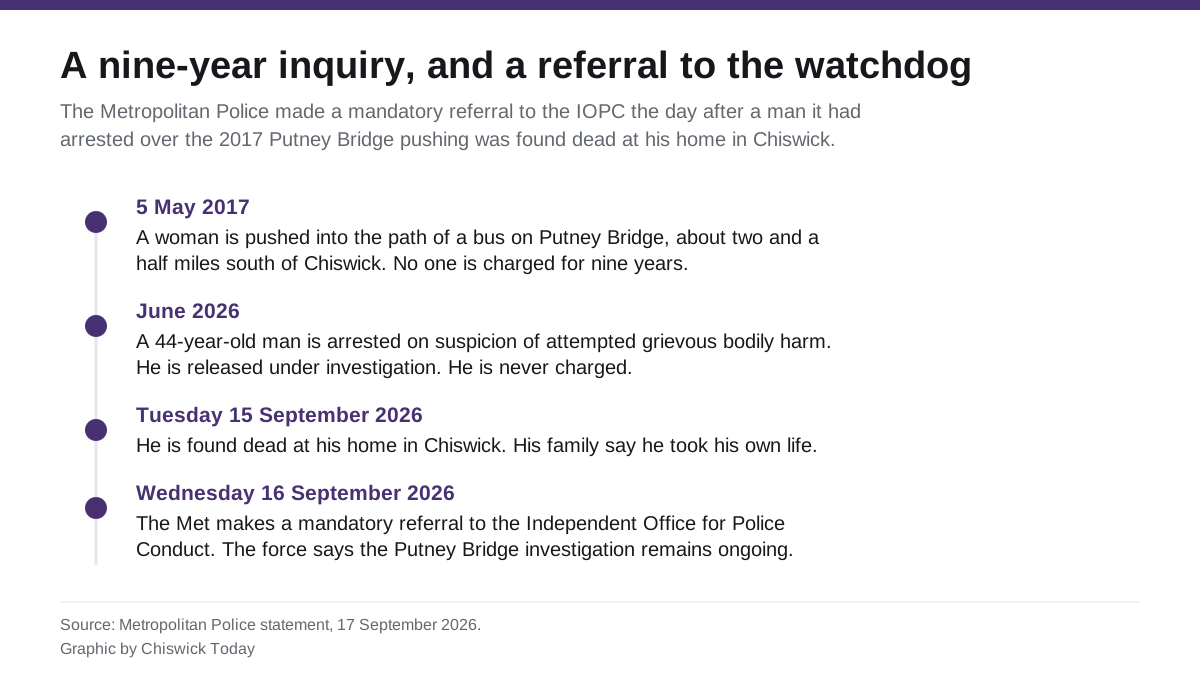
The Metropolitan Police has referred itself to the police watchdog after a man it had arrested over the 2017 Putney Bridge case was found dead at his home in Chiswick.
He was found on Tuesday 15 September. The force made a mandatory referral to the Independent Office for Police Conduct the following day, Wednesday 16 September.
The man was 44. He was arrested in June on suspicion of attempted grievous bodily harm and released under investigation. He was never charged with any offence.
His family say he took his own life, and blame the investigation. The Met says the Putney Bridge investigation has not closed.
If you are struggling, Samaritans is free to call on 116 123, at any hour, from any phone. There is more on how to contact Samaritans, including by email and in person.
Why we are not naming him
Chiswick Today is not naming the man. He was never charged, and no inquest into his death has opened.
Other outlets have named him, and his family named him themselves in a statement asking that he be cleared. We have taken only two things for this article: the statement issued by the Metropolitan Police, and the statement issued by his family. Nothing here comes from any interview, or from any other outlet’s own reporting.
What the Met has said
The force has published nothing about the death on its own newsroom. Its statement went to the news agencies instead, and has been carried in the same words by national outlets.
Chief Superintendent Dan Knowles, who leads policing in south west London, said the force’s thoughts were with the man’s family and friends “at this deeply distressing time”.
He added: “We recognise the significant impact his death will have on those who knew and loved him. We also understand the strain that being subject to a police investigation can place on individuals and their families.”
On the referral, the force said: “As is required whenever a person dies following previous contact with police, a mandatory referral was made to the Independent Office for Police Conduct (IOPC) on 16 September.”
The Met also made clear the 2017 case is still open. After the man was released under investigation, the force said, “it was made clear that inquiries would continue while officers progressed outstanding lines of inquiry and forensic examinations”. Its position is that “the investigation remains ongoing”.
That matters for anyone reading this as a case that has now been settled one way or the other. It has not been.
What his family have said
The man’s family issued a written statement on Thursday 17 September. They say he was not the man in the 2017 footage, and that the pressure of the investigation killed him.
They said he took his own life “after months of immense pressure caused by a Metropolitan Police investigation into whether he was the so-called ‘Putney Pusher’”, adding: “He was not.”
On the evidence, the statement said there was “no forensic evidence” linking him to the incident, “no evidence placing him on Putney Bridge at that time, and no credible evidence that he was the man shown in the footage”.
It also said: “He was left for months carrying the stigma of an appalling allegation which the police themselves clearly recognised was unsupported by the evidence.”
The family said he had lived with “the shame, anxiety, humiliation, and extraordinary pressure created by a wholly unnecessary investigation”.
The 2017 incident, and where it happened
The incident the man was arrested over took place on 5 May 2017 on Putney Bridge, where a jogger pushed a woman into the path of an oncoming bus.
Putney Bridge is not in Chiswick. It crosses the Thames between Fulham and Putney, about two and a half miles south of Chiswick High Road in a straight line. Both ends of it are in different boroughs from Chiswick. The Met officer who issued the statement leads policing in south west London, not here. The only part of this story that happened in Chiswick is the death.
No one was charged over the 2017 incident for nine years before the arrest in June.
What a mandatory referral actually means
A referral is not a finding, and it is not a complaint. It is a legal duty that lands automatically.
Under the Police Reform Act 2002, forces in England and Wales must refer any death during or following police contact to the IOPC. The test is whether there is an indication that the contact may have contributed to the death, directly or indirectly. The Met’s own statement describes this as required “whenever a person dies following previous contact with police”.
What happens next, according to the IOPC’s own account of its investigations:
- every referral is assessed first, and the IOPC says “all referrals are assessed on their own merit by our specialist assessment unit”
- if no investigation is needed, the matter can go back to the force to handle proportionately
- if there is an investigation, it takes one of three forms: independent, where “we investigate using our own investigators”; directed, where “we direct and control the investigation using police resources”; or local, where “the police force’s own professional standards department (PSD) investigates”
- at the end the IOPC produces a report, which in a death case goes to the family as well as the force
- the report goes to the Crown Prosecution Service only where the IOPC thinks an officer or member of staff may have committed a criminal offence, and to the coroner in any case where someone has died
The IOPC has not published anything about this referral. It does not routinely publish referrals while they are being assessed, so the absence of an IOPC statement does not tell you which way the assessment is going.
The numbers behind the category
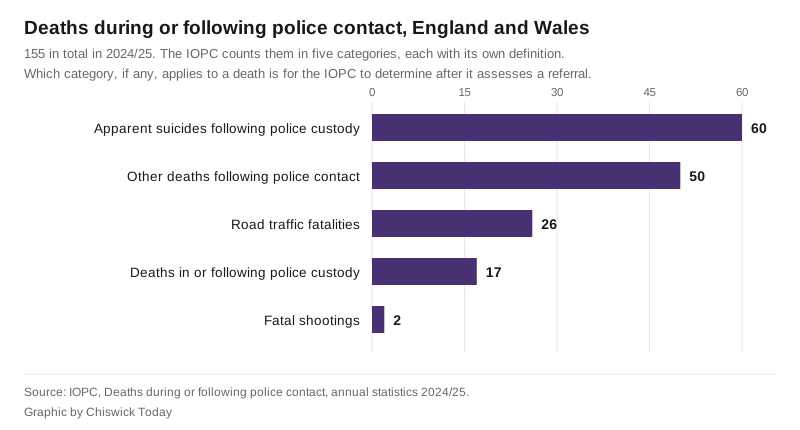
The IOPC counted 155 deaths during or following police contact in England and Wales in 2024/25. The five categories it uses are:
- apparent suicides following police custody: 60, of whom 56 were men and four were women, down from 68 the year before
- other deaths following police contact: 50, of whom 33 were men and 17 were women, down from 62
- road traffic fatalities: 26
- deaths in or following police custody: 17
- fatal shootings: 2
The definitions are narrower than the labels suggest. The IOPC counts an apparent suicide as “following police custody” where it happens within two days of release, or later where custody may still have been relevant. Its “other deaths following police contact” category covers deaths that “did not involve arrest or detention” and were subject to an independent IOPC investigation. That count therefore reflects investigation decisions, not how often such deaths occur.
Neither definition maps neatly onto what is known here: the man was arrested in June and died three months later, at home. Which category this death falls into, if any, is for the IOPC to determine.
What happens next
Three separate processes now run alongside each other.
- The IOPC assessment. It decides whether to investigate, and in what form. Nothing has been published.
- The coroner. Deaths in Chiswick are reported to West London Coroner’s Court, which covers Hounslow along with Hillingdon, Ealing, Richmond upon Thames, Kingston upon Thames and Hammersmith and Fulham. No inquest has opened.
- The Met’s own investigation into the 2017 incident, which the force says remains ongoing.
What it means for you
For most people in Chiswick this changes nothing practical, but three things are worth being clear about.
A referral is not a verdict. The Met referring itself is the law working as designed. It is not an admission, and it is not a finding against anyone. Equally, it is not a formality that can be waved away: the IOPC decides what happens, not the force.
The 2017 case is open. The Met has not closed the Putney Bridge investigation and has not said it has ruled anybody in or out. If you have information about it, the non-emergency police number is 101, or you can contact Crimestoppers anonymously on 0800 555 111.
Take care with what you share. The family’s complaint is partly about online speculation attaching an allegation to a man who was never charged. No inquest has opened and the investigation is unfinished, so anything circulating now is ahead of both.
Where to get help
If any of this has affected you, help is free and available at any time of day.
- Samaritans, 116 123, free from any phone, 24 hours a day. Email jo@samaritans.org, or see other ways to get in touch.
- Shout, which calls itself the UK’s free, confidential, 24/7 mental health text service: text 85258.
- Your GP, or NHS 111, which can direct you to urgent mental health support.
Have your say